
- High data freshness and quality
- Excellent coverage of B2B data
- Efficient bulk data download options
- Reliable API for data access
- Superior to competitors for targeting
- Complex initial tagging setup process
- Steep learning curve for beginners
- Requires technical knowledge for APIs
- High volume data management difficulty
- Manual filtering often still required

Quick Answer: Coresignal is a premier choice for high-scale public web data, offering 3B+ records across company and employee categories. It is highly recommended for investment firms and HR tech companies that need massive, fresh datasets rather than just a simple prospecting tool.
Best For: Data-driven organizations needing bulk access to professional and company metadata via API or large-scale transfers.
Key Takeaways:
- ✅ Massive scale with 839M+ employee records and 75M+ company profiles.
- ✅ High freshness across 15+ public web data sources for real-time tracking.
- ⚠️ Steep learning curve that requires technical staff to handle API and data management.
- 💰 Custom pricing model with a free tier available for testing.
Coresignal has spent over 9 years in the market refining how they gather and deliver public web data. This review looks at how they manage such a vast database and whether their technical approach fits your specific business needs this year.
Ratings Breakdown
Coresignal earns high marks for its sheer volume of data and the reliability of its delivery systems. While it lacks the “point-and-click” simplicity of some sales tools, it excels in technical depth.
| Category | Rating | Notes |
|---|---|---|
| Ease of Use | 6/10 | Requires technical skills for API and bulk data. |
| Features | 9/10 | Deep historical data and flexible API options. |
| Value for Money | 8/10 | High ROI for large-scale enterprise use cases. |
| Customer Support | 8/10 | Knowledgeable staff with quick response times. |
| Performance/Reliability | 9/10 | Consistent uptime and high data freshness. |
Overall: 8.0/10 – A powerful, industrial-grade data engine built for developers and data scientists.
Pros and Cons (The Real Deal)
Coresignal offers capabilities that small-scale scrapers cannot match. However, the complexity of managing millions of records means it is not a “plug-and-play” solution for every user.
✅ What Coresignal Gets Right
- Unrivaled B2B Data Coverage – With 839M+ employee records and 425M+ job postings, they offer one of the largest professional datasets available. This scale allows firms to map entire industries without missing smaller players or niche roles.
- Superior Data Freshness – The platform scans 15+ sources frequently to ensure records reflect current reality. This helps users avoid the common problem of outdated job titles or closed company locations.
- Efficient Bulk Download Options – Users can move massive datasets quickly through dedicated delivery channels. This is essential for companies training AI models or building internal databases.
- Reliable Programmatic Access – The API is built for stability and high-volume requests. Developers can integrate Coresignal into their own products with minimal downtime.
- Better Targeting for Investment – Their data helps investors track headcount changes and hiring trends. This provided a 65% increase in data-influenced investments for some users.
❌ Where Coresignal Falls Short
- Complex Initial Tagging Process – Setting up how you categorize and tag incoming data takes significant effort. If you don’t get this right at the start, your database will become messy and hard to search.
- Steep Learning Curve – Most of the value is locked behind technical interfaces. Non-technical users might struggle to extract the specific insights they need without help from a developer.
- High Volume Management Difficulty – Handling millions of JSON records requires a strong local infrastructure. You must have the storage and processing power 💻 ready to use what you buy.
- Manual Filtering Often Required – Even with advanced filters, some noise remains in the raw data. You will likely need to build your own cleaning scripts to reach 100% accuracy for sales outreach.
- Higher Technical Entry Barrier – Unlike simple Chrome extensions, Coresignal requires an understanding of APIs and webhooks. This makes it less accessible for a solo salesperson or a small startup.
What is Coresignal?
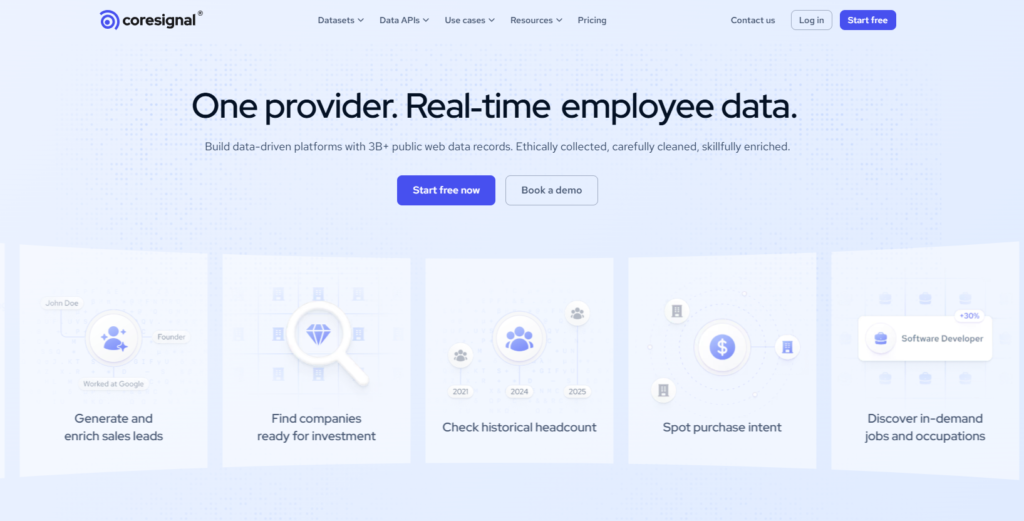
Coresignal started in 2016 to solve the problem of fragmented and stale public web data. Based in Lithuania, they have grown to support over 700 customers globally, including major investment firms and global enterprises.
The company focuses on providing “AI-ready” datasets by collecting data from 15+ different public sources. They employ 70+ technology specialists who focus exclusively on data extraction and cleaning. Their core value is providing a single point of access for 3B+ records, saving companies from building their own web scrapers.
Key Features (Deep Dive)
The platform is built around the idea of data as a raw material for other businesses. Their features reflect a focus on scale, history, and developer-friendly access methods.
Company API
This tool provides a gateway to 75M+ company records and 35M+ enterprises in their multi-source dataset. It allows you to pull firmographic details like industry, location, and founding date. You can use it to enrich CRM data or track the growth of competitors in real-time.
Employee API
The Employee API provides access to 839M+ professional profiles. It goes beyond names and titles to include skills, education, and past work history. This is often used by HR tech companies to power talent discovery or workforce planning tools.
Jobs API
With 425M+ job postings, this feature tracks the global labor market. It allows you to see which companies are hiring for specific roles, which signals growth or shifts in strategy. You can filter by salary, location, and required skills to get a clear view of market demand.
Historical Headcount API
This is a standout feature that tracks how a company’s workforce size changes over time. Instead of just seeing the current number, you get a trend line showing growth or layoffs. Investors use this to verify company health before making funding decisions.
Self-Service Platform
For those who don’t want to code immediately, this platform offers a way to preview and export data. It includes a search preview and a response field selection tool. You can use it to build your ideal dataset before committing to a bulk download.
Bulk Downloads and Webhooks
These delivery methods are designed for large-scale operations. Bulk downloads provide entire datasets for offline analysis, while webhooks alert your system when specific data points change. This ensures your local database stays synced with Coresignal’s master records.
Pricing and Plans
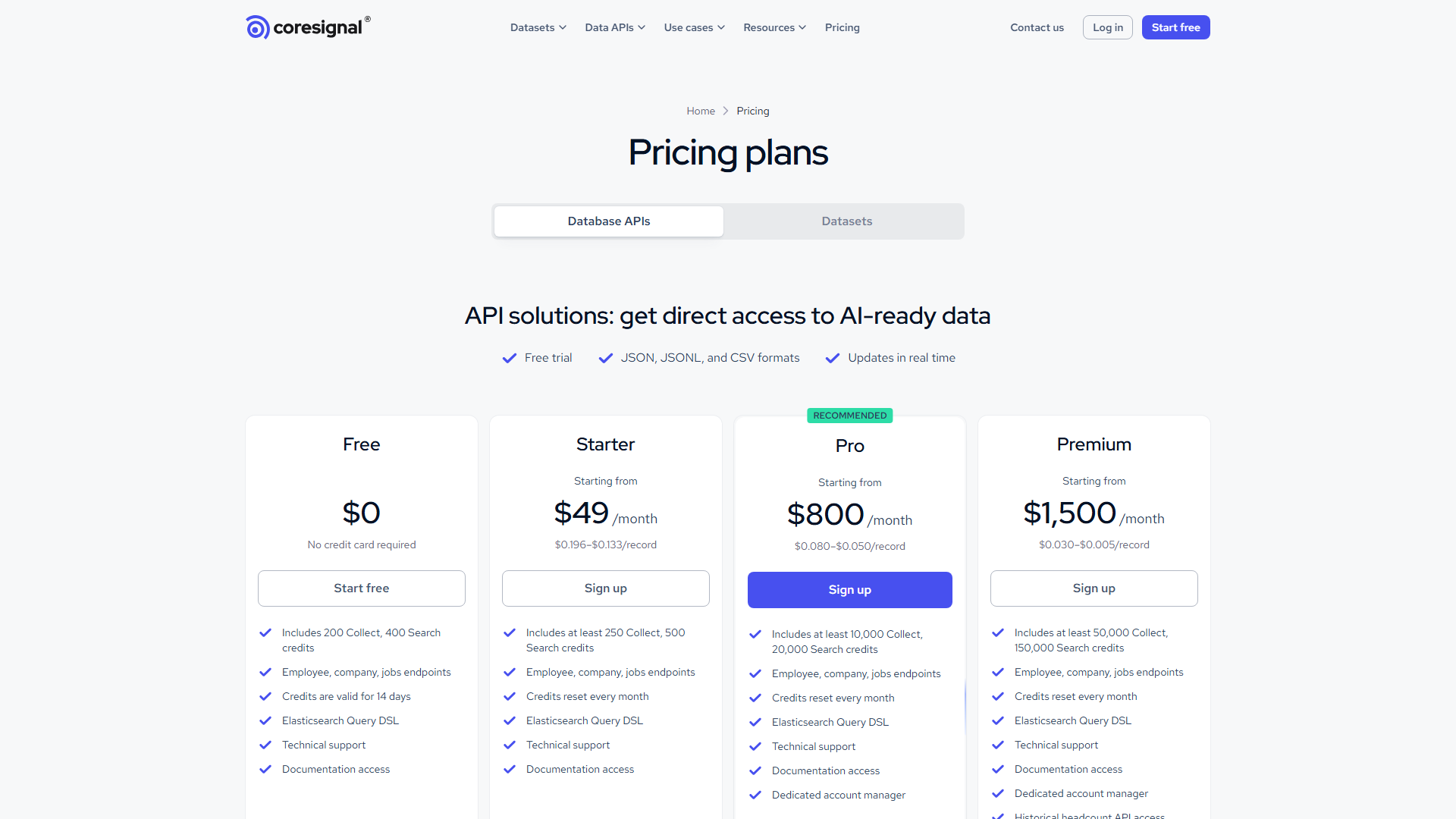
Coresignal uses a custom pricing model that scales with your data consumption. They do not publish a single “one size fits all” price because the needs of a hedge fund differ greatly from a small HR startup.
| Plan | Price | Best For | Key Limits |
|---|---|---|---|
| Free Tier | $0 | Testing & Devs | Low credit limit |
| Custom | Varies | Mid-Market | Negotiated records |
| Enterprise | Custom | Large Firms | Unlimited/Bulk |
Hidden Costs to Watch For
Managing the data you buy from Coresignal carries its own costs. You will need to pay for your own cloud storage and computing power to process billions of records. Additionally, if you exceed your monthly credit limit for API calls, you may face overage fees that were not in your original budget.
Is It worth the price?
If you are doing high-volume work, Coresignal is more cost-effective than building an in-house scraping team. The price per record drops significantly as you scale up. For small teams only looking for 100 leads a month, a simpler tool like Apollo or Lusha might be a better financial choice.
Ease of Use & Getting Started
Getting started with Coresignal is a professional-grade experience. While you can sign up for a free account to browse the data, the true setup process involves talking to their team to define your data needs.
The learning curve is noticeable because you are dealing with raw data types like JSON and JSONL. If you are comfortable with postman or writing Python scripts, you will find the documentation excellent. If you expect a “Find Leads” button that connects directly to your Gmail, you might feel overwhelmed by the technical requirements.
Integrations & API
Coresignal is built fundamentally as an API-first company. Their technical infrastructure is designed to be the “data plumbing” for your existing software stack.
API Quality: The REST APIs are well-documented and offer high performance with low latency. They allow for complex filtering, so you only pay for and download the exact data points you need.
Workflows: While they don’t have as many “one-click” CRM buttons as some sales tools, they support technical workflows via Zapier and webhooks. This allows you to build custom automations that trigger when a company’s headcount changes or a new job is posted.
Customer Support
Support at Coresignal is handled by 70+ technology specialists who understand the data they sell. You won’t just get a generic script reader; you get someone who can help with API queries.
They offer email and chat support, with dedicated account managers for enterprise clients. The documentation is a high point, featuring clear examples of JSON responses and detailed field descriptions. Their community and help center are updated often to reflect new data sources or API changes.
Security & Compliance
Coresignal takes an ethical approach to data collection, which is vital in a market facing heavy regulation. They focus on public web data and aim for full compliance with GDPR and CCPA.
Data is gathered from public sources where users have chosen to share their information. This legal clarity is important for large organizations that cannot risk using “gray market” data. They maintain high uptime and offer Service Level Agreements (SLAs) for enterprise customers to ensure data availability.
Who Should Use Coresignal?
Coresignal fills a specific gap in the market for high-volume, high-quality professional data. It sits between basic lead providers and expensive custom market research firms.
Perfect for: Investment Firms – Hedge funds and VC firms use the historical headcount data to spot rising stars before they hit the mainstream.
Great for: HR Tech Platforms – Companies building job boards or talent matching tools can use the Jobs API to populate their databases instantly.
Also suits: Sales Intelligence Providers – Other software companies buy bulk data from Coresignal to power their own “lookalike” or “lead scoring” features.
❌ Coresignal is NOT For You If…
- You need a simple CRM extension – If you just want to find one person’s email while browsing a profile, this tool is too complex and expensive.
- You don’t have a developer – Without someone to handle the API integration or data cleaning, the raw files will be difficult to use effectively.
- Your budget is very tight – The value in Coresignal comes from scale, and the custom pricing usually starts at a level higher than basic chrome-extension tools.
What Real Users Are Saying
user feedback generally highlights the technical superiority of the data. Most reviews come from data scientists, analysts, or product managers who rely on bulk information.
Most Praised: Data freshness is the most common compliment, followed by the ease of bulk downloads. Users also appreciate that the coverage of international markets is better than many US-centric competitors.
Most Criticized: The difficulty of the initial setup and the potential for “data noise” are frequent complaints. Some users find that managing the sheer volume of records requires more engineering time than they expected.
Average Rating: 4.5/5 across major platforms like G2 and Capterra.
One user noted that their pipeline grew by 40% after six months of using Coresignal data to target the right companies. Another mentioned that the data accuracy allowed them to automate 90% of their market research.
Top Alternatives to Consider
Coresignal competes with a mix of database providers and specialized scraping tools. Here is how it stacks up against the most common alternatives.
| Alternative | Best For | Starting Price | vs Coresignal |
|---|---|---|---|
| Apollo.io | Sales teams | $49/mo | More user-friendly, less raw data depth |
| Proxycurl | LinkedIn scrapers | Pay-per-use | Better for single profile lookups |
| ZoomInfo | Enterprise sales | High (Custom) | Better for direct phone numbers |
Common Issues & How to Fix Them
Even the best data providers have friction points. Here are a few ways to handle the most common hurdles when using Coresignal’s systems.
Complex Tagging Setup
- Problem: Users struggle to categorize the massive influx of data.
- Solution: Spend time during the pilot phase mapping Coresignal’s fields to your internal database structure. Use their field selection tool to only download what you actually use.
Data Volume Management
- Problem: Systems slow down when trying to process millions of JSON records.
- Solution: Implement a staged processing pipeline. Use an S3 bucket for raw storage and a high-performance database like Elasticsearch for querying.
Initial Learning Curve
- Problem: New users feel lost without a point-and-click interface.
- Solution: Start with the self-service platform to visualize the data. Read the API docs thoroughly before writing any integration code.
Final Verdict
Coresignal is a heavyweight in the web data space. It provides the scale and freshness that sophisticated businesses need to make data-driven decisions. If you have the technical resources to manage large datasets, it is one of the most reliable sources of B2B intelligence available this year.
For teams that need more than just a list of names, Coresignal offers the deep metadata and historical context required for serious analysis. It isn’t the cheapest or easiest tool, but it is among the most powerful for enterprise-level data collection.
Rating: 8.5/10 – The premier data engine for organizations that treat information as a core asset.
FAQ
What is the difference between Search credits and Collect credits?
Search credits are used when you query the database to find specific records meeting your criteria. Collect credits are spent when you actually retrieve the full data for those records. This split allows you to narrow down your target list without paying for the full data of every potential match.
Does Coresignal offer historical data tracking?
Yes, Coresignal is known for its historical headcount API. This allows you to see how a company’s staff size has changed month-over-month or year-over-year. It is a critical feature for investors looking to verify a company’s growth claims.
How does Coresignal compare to Proxycurl for prospecting?
Proxycurl is often used for real-time scraping of a specific person’s profile. Coresignal is better for bulk use cases where you need a pre-built, searchable database of millions of records. If you need to build a whole software product, Coresignal is the better choice.
Is Coresignal suitable for custom web scraping?
Coresignal is primarily a provider of pre-built databases and APIs rather than a general-purpose scraping tool. While they cover 15+ sources, you cannot point them at a random website to extract data. You are buying access to their massive, existing collection of public web data.
What is the actual starting cost for datasets?
Because pricing is custom, there is no single starting price. However, most enterprise-level data subscriptions are priced based on the volume of records or the frequency of updates. Small teams can start with the free tier to test the data, but significant projects usually require a negotiated contract.
