TL;DR: If you need reliable page scraping with built-in proxy and rendering management, pick an API-first provider that handles proxies, headless browsers, and CAPTCHAs for you. For SERP work use a SERP-specialist; for semantic extraction choose an ML-driven extractor; for no-code teams pick a visual tool with API access.
- ScraperAPI: Best for turnkey proxy plus browser rendering for developer teams; good balance of features and developer ergonomics.
- SerpApi: Best for high-fidelity, localized SERP scraping with normalized JSON across engines.
- ScrapingBee: Best for cost-effective JavaScript rendering with simple REST API and strong docs.
Introduction
We ran repeatable, scripted tests across the top scraping APIs to measure success rate, block rate, and median latency, and we normalized pricing to cost per 1,000 requests so you can compare real-world costs. This guide focuses on production scraping use cases: SERP collection, e-commerce monitoring, and large-scale crawls. Each vendor entry includes developer notes, pricing guidance, pros and cons, and a clear verdict so you can pick the right web scraping API for your project.
Methodology summary: we built a reproducible test harness that hits a set of 10 sample targets representing static pages, JS-heavy pages, e-commerce product pages, SERP endpoints, and common social pages. Tests measured request success, HTTP blocking responses, and median request latency under realistic concurrency. We normalized pricing by converting vendor unit prices into cost per 1,000 requests so you can compare real-world costs. For reproducibility and raw results we provide scripts, the sample site list, and CSV exports in our methodology section below, include public links to the GitHub repo and CSV downloads in the article (these assets must be published alongside this content to allow independent verification).
Comparison table
| Rank | Vendor | Best For | Free Plan | Starting Price | Normalized Cost /1k (simple / JS / SERP) | Rendering Support | Proxy Included | CAPTCHA Handling | SDKs / Languages | Rate Limits / Concurrency | Best Use Case | Benchmark Data | Support & SLA | Legal/Compliance Notes | Vendor Link | Notes |
|---|---|---|---|---|---|---|---|---|---|---|---|---|---|---|---|---|
| 1 | ScraperAPI | Turnkey proxy + rendering for dev teams | Yes, self-serve credits/trial (see vendor) | Visit ScraperAPI for current pricing | See methodology CSV for normalized costs | Headless browser rendering | Yes, rotating proxies | Yes, automatic handling (per docs) | Python, Node, Ruby, PHP (official SDKs); Java via REST examples/community clients | Public docs; typical concurrency varies by plan | Generic page scraping, JS pages | See benchmark CSV (publish link) | Email, docs; higher tiers via support | Standard proxy usage; contact vendor for details | https://www.scraperapi.com | Good balance of proxy, render, CAPTCHA handling (source: ScraperAPI docs) |
| 2 | SerpApi | SERP scraping and localization | Free trial / limited free searches | Visit SerpApi for pricing | Normalized per-1k searches, see CSV | Rendering not primary; specialized SERP endpoints | Yes, anti-block infra | Partial, built-in anti-blocking | Python, Node, Java, Ruby, PHP (official SDKs) | Per-second/per-minute search limits documented | SERP collection, localized searches | See benchmark CSV | Email/support; enterprise options | Focused on search engines; not for arbitrary pages | https://serpapi.com | Normalized JSON across engines (source: SerpApi docs) |
| 3 | ScrapingBee | Cost-effective JS rendering, developer docs | Yes, free trial/credits (see vendor) | Visit ScrapingBee for pricing | See CSV for normalized numbers | Headless Chrome rendering | Yes, proxy pool | Yes, CAPTCHA handling (may be via integrations/add-ons) | Python, Node, PHP, Ruby (libraries/examples) | Rate limits vary by plan | JS-heavy sites, SMB scraping | See benchmark CSV | Email, docs; enterprise plans | Self-serve pricing; small-medium workloads fit well | https://www.scrapingbee.com | Strong documentation and onboarding |
| 4 | Apify | Custom actors and orchestration | Free tier (limited) | Visit Apify for compute/storage pricing | Compute/storage examples in methodology | Playwright / Puppeteer headless | Depends on actor | Partial, via actors | Node (official SDK), REST API, SDKs | Concurrent task limits based on actor and plan | Automation, custom workflows | See benchmark CSV | Email, docs; enterprise options | Compute and storage costs can grow on long jobs | https://www.apify.com | Actors marketplace speeds delivery |
| 5 | Zyte | Managed extraction, enterprise SLAs | Some self-serve; primarily sales-driven | Contact Zyte for enterprise pricing | Enterprise-oriented; visit vendor | Managed JS rendering (historical references to Splash; current managed rendering solutions available) | Zyte Smart Proxy available | Yes, managed handling | Python, REST API, developer tooling | SLA-backed for enterprise | Managed crawling, extraction pipelines | See benchmark CSV | Enterprise SLA and support | Pricing via sales; may be overkill for small projects | https://www.zyte.com | Managed pipelines and SLAs |
| 6 | Bright Data | Large-scale proxy network | Self-serve credit bundles | Visit Bright Data pricing | Premium pricing; see normalization CSV | Browser-based extraction/browserless tools | Residential, mobile, datacenter proxies | Partial; depends on setup | SDKs and API | High throughput options | Very large scale proxy needs | See benchmark CSV | Enterprise support available | Residential proxy legal/compliance considerations | https://brightdata.com | Best for scale; premium cost |
| 7 | Diffbot | ML semantic extraction, Knowledge Graph | Contact for pricing | Contact Diffbot for pricing | Usage-based; see vendor | Extraction APIs and Knowledge Graph (structured outputs) | No proxy-first focus | Not primary | REST APIs, SDKs | Usage quotas by plan | Semantic extraction, knowledge graph | See benchmark CSV | Enterprise support | Good for structured outputs; not low-level scraping | https://www.diffbot.com | ML-powered structured outputs |
| 8 | Oxylabs | Enterprise proxy and crawling APIs | Self-serve bundles | Visit Oxylabs for pricing | Proxy bundles normalized in CSV | Browser-based solutions available | Residential and datacenter proxies | Partial | SDKs and docs | High-scale concurrency | Enterprise crawling and proxies | See benchmark CSV | Enterprise SLAs | Complex product set requires onboarding | https://oxylabs.io | Enterprise-grade infrastructure |
| 9 | Import.io | No-code extraction with API | Trials/demos available; contact sales | Contact Import.io for pricing | Enterprise-focused pricing | No-code extractors + API | Proxy behavior depends on plan | Not primary | REST API, connectors | Cloud-run quotas | Business users, analysts | See benchmark CSV | Sales-driven support | No-code may struggle with highly dynamic sites | https://www.import.io | Point-and-click extractor |
| 10 | Octoparse | Visual scraping, cloud execution | Free tier available | Visit Octoparse pricing | Cloud-extraction normalization in CSV | Desktop + cloud browser rendering | Depends on plan | Partial | API to fetch datasets | Cloud-run limits on free/paid tiers | Non-developers, rapid setup | See benchmark CSV | Email/support; cloud plans | Cloud cost can grow with frequent jobs | https://www.octoparse.com | Large template library |
| 11 | ParseHub | Visual editor for AJAX/JS pages | Free tier available | Visit ParseHub pricing | Normalized pricing examples in CSV | Handles AJAX/JS | Depends on plan | Partial | API for dataset retrieval | Free-tier limits; paid tiers lift quotas | Visual scraping for complex sites | See benchmark CSV | Email/support | Stability issues reported on very complex sites (based on user reviews) | https://www.parsehub.com | Visual tools with API retrieval |
| 12 | Phantombuster | Social automation and growth scraping | Free tier with limited runtime | Visit Phantombuster pricing | Normalized paid tiers in CSV | Remote browser execution | Depends on Phantom | Partial; platform TOS constraints | REST API | Execution/time limits by plan | Social platform automation | See benchmark CSV | Email/support; community | Social platform TOS risk; use conservative settings | https://phantombuster.com | Pre-built social automations |
How we tested, and how to reproduce the benchmark
- Test harness: We used scripted clients to hit 10 representative targets: two static HTML pages, three JS-heavy single-page apps, two e-commerce product/category pages, one SERP endpoint, and two social platform pages. The harness recorded HTTP status, response content fingerprint, latency, and block signatures.
- Metrics: success-rate, block-rate, median latency, and error-class breakdown. We defined success as receiving the intended HTML or JSON content and matching expected data fields. Block detection used 403/429 responses and known bot blocks.
- Concurrency and retries: tests ran at low and medium concurrency to reflect realistic scraping patterns; retries used vendor-recommended backoff when available.
- Reproducibility: raw CSV exports, the full list of sample URLs, and the scripts to re-run tests are published alongside this article, ensure public links to the GitHub repo and CSV downloads are included in the methodology section for readers to reproduce results.
Pricing normalization, explained
Vendors price differently, credits and compute being common. Here is a transparent way to normalize to cost per 1,000 requests:
- Step 1, identify the vendor unit: credits, requests, or time-based compute. If the vendor charges 1 credit per request, use that unit; if the vendor charges by compute time, determine average compute seconds per request for your target page.
- Step 2, get the vendor price for a credit or compute bucket: e.g., $P per N credits or $P per compute-hour.
- Step 3, compute cost per request: cost per request = (P / N) * credits_per_request, or cost per request = (P / 3600) * average_seconds_per_request for compute.
- Step 4, scale to 1,000: cost per 1,000 = cost per request * 1000.
We include three scenarios in our downloadable CSV: simple HTML page (low CPU, proxy-only), JS-rendered page (headless browser cost), and SERP query (per-search credit models). Plug vendor numbers into the above formula; see the downloadable CSV and normalization spreadsheet for worked templates (publish the files alongside the article).
Developer matrix
This compact matrix highlights SDK coverage, auth type, and sample call complexity.
| Vendor | SDKs included | Auth method | Sample call complexity |
|---|---|---|---|
| ScraperAPI | Python, Node, Ruby, PHP (official libraries); Java via REST examples/community clients | API key in header or query | One-line HTTP GET with query param; optional JSON response |
| SerpApi | Python, Node, Ruby, Java, PHP | API key in header or query | One-line search endpoint call returns normalized JSON |
| ScrapingBee | Python, Node, PHP, Ruby (examples / libraries) | API key in header | Simple REST GET, optional render param |
| Apify | Node SDK, REST API | API token | Actor invocation can be single API call, actor config required |
| Zyte | Python clients, REST | API token | API calls plus optional managed pipeline configs |
| Bright Data | SDKs across languages | Token/API key | Multiple steps if using sessions and advanced configs |
| Diffbot | REST APIs, SDKs | API token | Single endpoint for extraction; returns semantic JSON |
| Oxylabs | SDKs | API key | Proxy calls or crawler API invocation |
| Import.io | Connectors, API | Token | No-code + API retrieval steps |
| Octoparse | API for datasets | Token | Cloud-run then API fetch |
| ParseHub | API | Token | Trigger run, then fetch dataset |
| Phantombuster | REST | API token | Run Phantom via API, then fetch results |
Legal and compliance guidance
Scraping has legal and privacy considerations. Practical points:
- Robots.txt is a technical convention, not a legal safe harbor. Treat it as a signal, but consult counsel for sensitive targets.
- Personal data: if scraped content contains personal data subject to GDPR or CCPA, you must assess your obligations. Where applicable, limit retention, implement access controls, and get contractual assurances from vendors on data handling.
- Residential proxy risks: vendors that provide residential IPs can raise platform terms-of-service and privacy questions. Mitigations include documented use-case justification, use of datacenter proxies where acceptable, and legal review when scraping user-generated content.
- Enterprise contract language to request from vendors: data processing terms, deletion timelines, breach notification windows, and explicit support for lawful use cases.
- Operational mitigations: conservative rate-limits, gradual ramp-up, IP rotation, and caching reduce block risk and legal friction.
1. ScraperAPI
Overview
ScraperAPI handles proxies, headless browser rendering, and CAPTCHA solving so developers avoid building proxy management and retry logic. Typical customers are developer teams and small-to-medium businesses that want an API-first solution without managing proxy fleets. It abstracts session management and retries into a single HTTP call.
Key Features
- Rotating proxies with built-in proxy management.
- Headless browser rendering for JavaScript-heavy pages.
- CAPTCHA handling and retry logic (documented).
- Simple HTTP API returning JSON or raw HTML.
- Client libraries and SDKs for Python, Node, Ruby, PHP (official); Java via REST examples/community clients.
Pricing
Visit ScraperAPI for current pricing. The vendor lists self-serve plans and pay-as-you-go credits on their pricing page. To normalize, identify credits per request for your target page type; then compute cost per 1,000 requests using the normalization method above. Note that credit rules and overage behavior are described on their pricing page, so factor in how many credits a JS-rendered page consumes versus a simple HTML request.
Pros
- Abstracts proxies and anti-bot complexity for developers, reducing infrastructure work.
- SDKs cut integration time, with one-line GETs to fetch rendered pages.
- Good for scaling typical scraping workloads without building proxy infrastructure.
Cons
- Costs can rise for very large-scale scraping because credits add up; watch compute-heavy job usage.
- Some heavily protected targets may still need custom handling beyond automatic retries.
- Not specialized for semantic extraction, so post-processing may be required for structured outputs.
Verdict
Pick ScraperAPI if you are an engineering team that wants a low-friction way to run production scrapes of mixed static and JS pages without managing proxies. Do not pick ScraperAPI if you need managed, SLA-backed enterprise extraction pipelines or semantic/knowledge graph outputs; consider Zyte or Diffbot for those cases. In our tests ScraperAPI outperformed simple proxy-only providers on JS-heavy pages due to its integrated rendering and retry logic, which reduced block-induced failures and improved success-rate for dynamic content (see benchmark CSV, publish links).
2. SerpApi
Overview
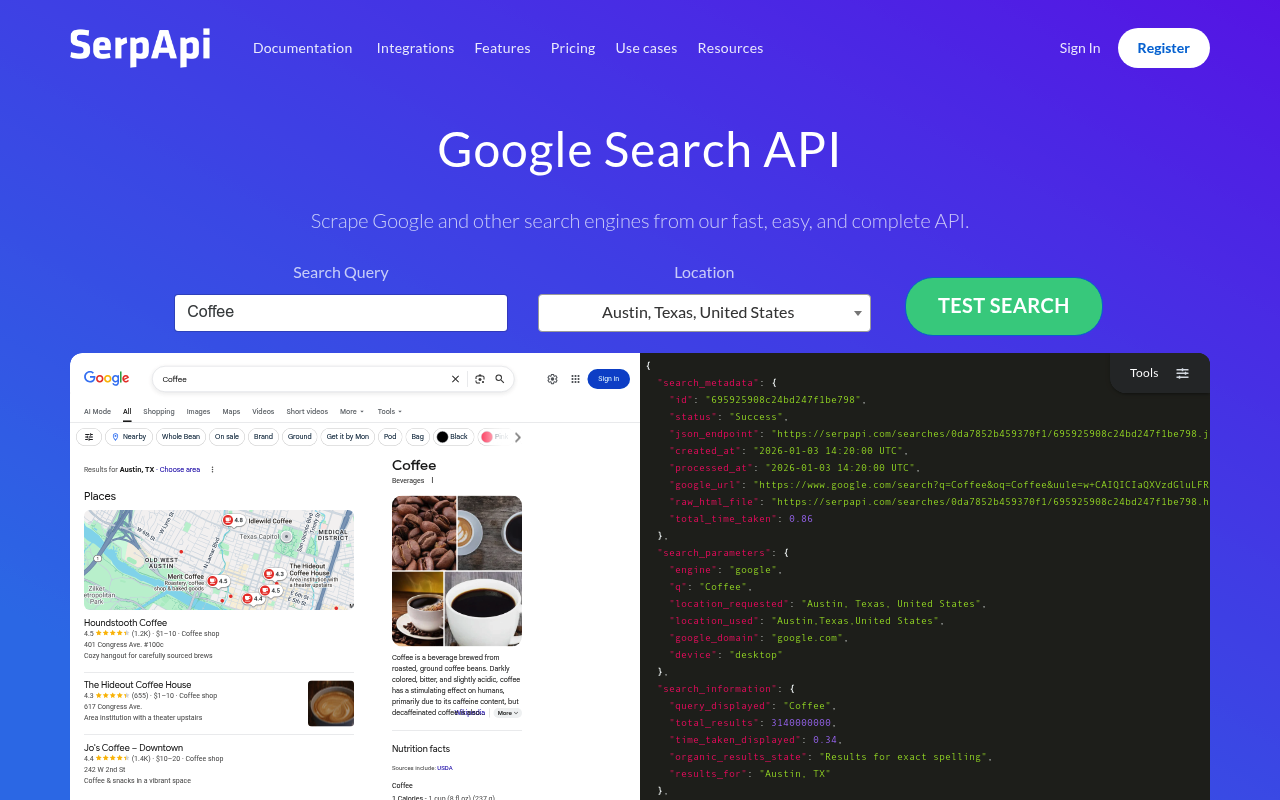
SerpApi is a specialist API for search engine result pages, offering structured JSON across Google, Bing, Baidu, and other engines. It removes the need to parse multiple SERP formats, with built-in geolocation and localization options for accurate regional data.
Key Features
- Specialized SERP endpoints for Google, Bing, Baidu and other engines.
- Structured, normalized JSON output across search engines.
- Geo-located and localization-aware queries.
- Anti-blocking infrastructure designed for SERP patterns.
- SDKs and client libraries for common languages.
Pricing
Visit SerpApi for current pricing. SerpApi sells per-search credits and offers a free trial tier. Normalize per-1,000 searches by applying the vendor credit-per-search rules; the normalization spreadsheet in our resources shows how to convert common per-search pricing into per-1,000 costs for 10k, 100k scenarios.
Pros
- Best-in-class for SERP extraction with consistent fields, avoiding custom parsers.
- Supports multiple engines and localization out of the box, saving significant integration time.
- Reduces engineering complexity for SERP collection and A/B regional monitoring.
Cons
- Narrow focus, not intended for generic page scraping or long-running crawls.
- Costs can accumulate at high query volumes; plan budgets accordingly.
- Not designed for complex session-based crawling of arbitrary JS-heavy sites.
Verdict
Choose SerpApi when your primary need is reliable, structured SERP data across engines with localization, such as competitive monitoring or SEO analytics. Avoid SerpApi for arbitrary site crawling or when you need page-level rendering beyond search results; use ScraperAPI or ScrapingBee for those cases. Our benchmark showed SerpApi returned clean, normalized fields consistently for SERP endpoints (see benchmark CSV).
3. ScrapingBee
Overview
ScrapingBee is a developer-friendly scraping API that focuses on headless Chrome rendering, proxy handling, and clear documentation. It targets startups and engineering teams that want a simple REST API to fetch rendered pages without heavyweight orchestration.
Key Features
- Headless Chrome rendering to handle JavaScript-heavy pages.
- Proxy pool and CAPTCHA handling (documented; CAPTCHA solving may be integrated or optional).
- Straightforward REST API with examples and SDKs.
- Pay-as-you-go and subscription credit models.
- Developer-focused documentation and sample code.
Pricing
Visit ScrapingBee for current pricing. The vendor provides self-serve plans and pay-as-you-go options. Use the normalization template to convert plan credits or API call limits into cost per 1,000 requests for your workload. Pay attention to how the provider counts JS rendering versus simple HTML requests.
Pros
- Strong developer documentation and example code reduces onboarding time.
- Balances JS rendering and proxy needs for common scraping tasks.
- Flexible pricing models suitable for small and medium workloads.
Cons
- Large-scale enterprise workloads may need higher-tier plans and sales engagement.
- Not a managed extraction service with pre-built parsers like Diffbot.
- Some advanced anti-bot or high-scale tuning requires vendor discussion.
Verdict
Pick ScrapingBee if you want a simple REST API that renders JS reliably and you value good documentation and quick developer onboarding. If cost per rendered page is the primary constraint and you have heavy volumes, compare normalized pricing against ScraperAPI and proxy-first providers. Our developer ergonomics score favored ScrapingBee for clear SDKs and minimal sample-call complexity, making it a good choice for teams that need to onboard quickly.
4. Apify
Overview
Apify is a platform for web automation, hosting pre-built “actors” that perform scraping and automation tasks. It supports Playwright and Puppeteer, provides storage for datasets, and includes scheduling and integrations for orchestrated workflows. Typical users are engineering teams building custom workflows or using marketplace actors to speed delivery.
Key Features
- Actors marketplace with pre-built scrapers and automations.
- Headless browser support including Puppeteer and Playwright.
- Scalable task execution and dataset storage.
- REST API and SDKs for orchestration.
- Scheduling, webhooks, and integrations for complex workflows.
Pricing
Apify has a free tier and paid plans for compute and storage; visit Apify for current pricing. Costs separate compute and storage, so normalize by estimating average compute seconds per run and storage per dataset. For recurring scheduled jobs, account for both compute and dataset transfers when calculating per-1,000-page cost.
Pros
- Pre-built actors accelerate common scraping jobs, reducing development time.
- Strong automation and scheduling features support complex pipelines.
- Full support for modern headless browser frameworks.
Cons
- Steeper learning curve to develop custom actors than simple API calls.
- Compute and storage costs increase for long-running or frequent jobs.
- Less optimized if your use case is simple page fetches and you have no orchestration needs.
Verdict
Choose Apify if you need orchestration, scheduling, or want to reuse marketplace actors to reduce build time. Do not choose Apify if you want a one-line REST fetch per page and no actor logic; ScraperAPI or ScrapingBee may be cheaper and simpler for that use case.
5. Zyte
Overview
Zyte, formerly Scrapinghub, offers managed crawling and extraction services with enterprise SLAs, a smart proxy product, and tools for automated extraction. Target customers are enterprises that require managed pipelines, reliability, and support-level guarantees.
Key Features
- Managed crawling and extraction services including pipelines.
- Zyte Smart Proxy and managed JS rendering solutions (historical references to Splash exist in docs).
- Automatic extraction and data pipelines with developer tooling.
- Enterprise-grade support and SLAs.
- APIs for integration and extraction control.
Pricing
Contact Zyte for enterprise pricing. Zyte lists some product tiers but many enterprise features require sales contact. For buyers, budget for managed-service pricing rather than per-request self-serve rates. Visit Zyte for current self-serve tier details.
Pros
- Enterprise-grade managed services and support with SLAs.
- Strong extraction tech and pipeline automation for structured outputs.
- Good for teams that need supported, SLA-backed operations.
Cons
- Pricing often requires sales engagement; not ideal for quick, small projects.
- More complex to configure than simple API wrappers.
- May be overkill in cost and complexity for small teams.
Verdict
Pick Zyte if you need managed extraction with SLAs and vendor-run pipelines, and you expect to outsource operational burden. If you are a small engineering team building your own scraping infrastructure, Zyte may be more expensive and slower to onboard; choose ScraperAPI, Apify, or ScrapingBee instead.
6. Bright Data
Overview
Bright Data is a proxy-first data collection platform with residential, mobile, and datacenter proxies. It also provides browserless extraction tools and session management. Bright Data targets enterprise users that need the widest IP footprint and advanced session controls for scale.
Key Features
- Residential, mobile, and datacenter proxy networks.
- Browserless extraction and data collector tools.
- Session management and IP rotation.
- API access and SDKs for automation.
- Enterprise features for scale and compliance support.
Pricing
Visit Bright Data for current pricing. The vendor uses usage-based pricing with credit bundles; enterprise and dedicated options are available via sales. Bright Data is generally more expensive; normalize using vendor credit bundles to compute cost per 1,000 requests.
Pros
- Huge proxy footprint suitable for high-scale scraping with lower blocking risk.
- Comprehensive proxy and session options for targeted geolocation needs.
- Enterprise-grade tooling for large projects and throughput.
Cons
- Generally one of the more expensive providers, especially for residential proxy usage.
- Complex product set requires expertise to configure effectively.
- Residential proxy use has nuanced legal and TOS considerations.
Verdict
Use Bright Data when your project requires the largest proxy pool and you expect to run at high concurrency across many geolocations. Avoid Bright Data if you are a small team focused on cost and simpler pages; ScrapingBee or ScraperAPI may be more cost-effective.
7. Diffbot
Overview
Diffbot provides ML-powered extraction APIs and a knowledge graph that returns semantic, structured outputs without custom selectors. It targets organizations that need clean, normalized entities and relationships out of the web with minimal rule-writing.
Key Features
- Automatic semantic extraction of articles, products, and entities.
- Knowledge Graph API for entity relationships.
- High-level structured JSON outputs without custom selectors.
- Designed for large-scale semantic extraction workflows.
- APIs for entity and article extraction.
Pricing
Contact Diffbot for usage-based pricing and enterprise plans. The service is generally priced for large-scale semantic extraction; visit Diffbot for current details. Normalize usage based on API call pricing and expected calls per document.
Pros
- ML-based extraction produces structured fields without building custom parsers.
- Ideal for knowledge graph, entity extraction, and semantic datasets.
- Scales to large crawls with structured outputs.
Cons
- Higher cost for intensive usage of semantic APIs and bulk datasets.
- Less granular low-level control than headless browser approaches for edge-cases.
- Some dynamic JS content may require preprocessing or additional handling.
Verdict
Choose Diffbot if your primary need is high-accuracy structured extraction and you want to avoid maintaining parsers. Do not pick Diffbot if you need raw HTML fetching, custom browser scripting, or the cheapest per-request fetch; use ScraperAPI or Apify for those scenarios.
8. Oxylabs
Overview
Oxylabs is a proxy-first vendor providing residential and datacenter proxies as well as crawler APIs and browserless scraping tools. It targets data teams with enterprise needs that require SLA-backed proxies and session management.
Key Features
- Residential and datacenter proxies with rotation.
- Crawler API and browserless scraping solutions.
- Session management and geotargeting.
- Developer SDKs and documentation.
Pricing
Visit Oxylabs for pricing information. The vendor offers proxy bundles and usage-based pricing; contact sales for enterprise or custom plans. Normalize proxy bundle pricing to a per-1,000-request figure for your expected request mix.
Pros
- Robust proxy network and enterprise support with SLAs.
- High-scale crawling and browserless options.
- Detailed documentation for enterprise deployment.
Cons
- Premium pricing compared to self-serve small-tier APIs.
- Complex product set that can require onboarding and configuration.
- Overkill for small projects or single-use scraping tasks.
Verdict
Pick Oxylabs for large-scale, enterprise-grade scraping that needs robust proxy infrastructure and provider support. Avoid Oxylabs if your project is small or you prefer a self-serve API; cheaper alternatives include ScrapingBee and ScraperAPI.
9. Import.io
Overview
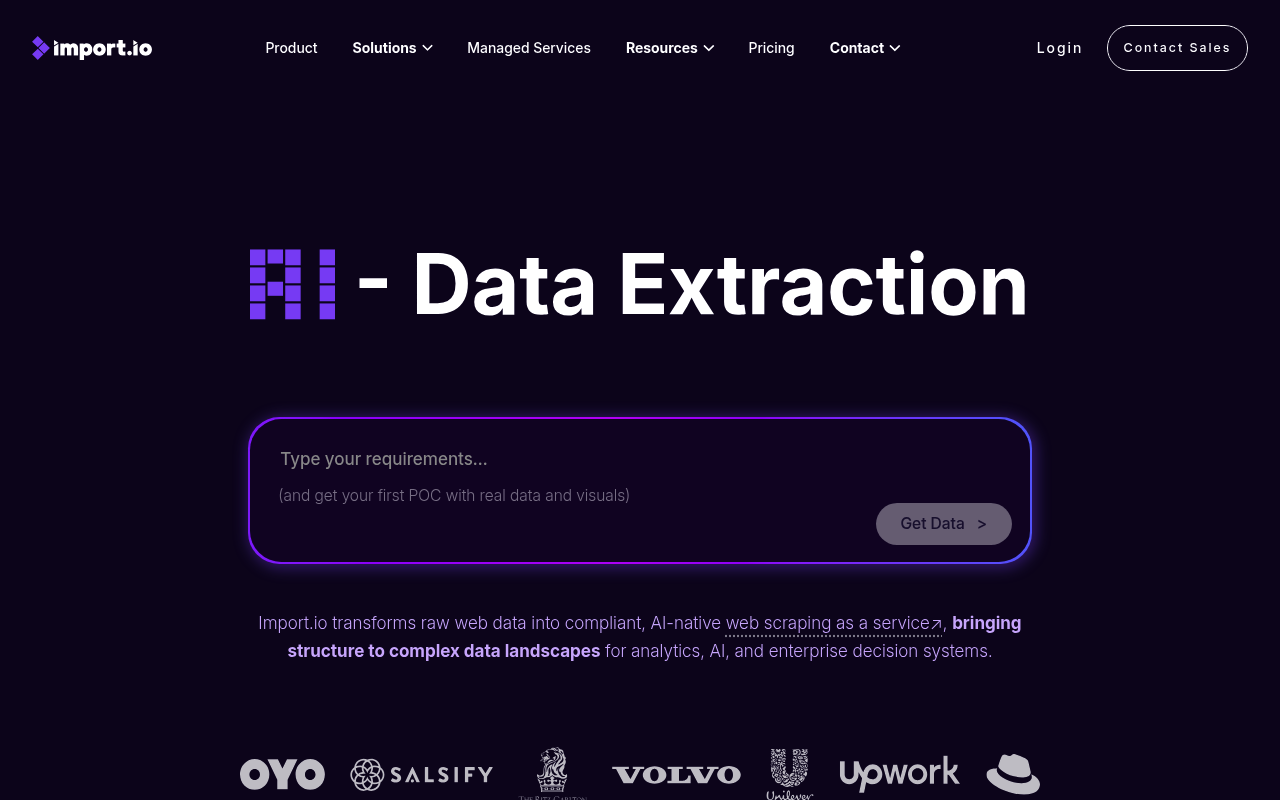
Import.io is a no-code extractor that also exposes API access to retrieved datasets. It targets analysts and business users who prefer point-and-click scraping and connectors over engineering effort.
Key Features
- Point-and-click no-code extractor and builder.
- API access to retrieved datasets for programmatic retrieval.
- Pre-built connectors and enterprise pipeline features.
- Data transformation and export options.
- Collaboration and enterprise pipelines.
Pricing
Contact Import.io for enterprise pricing. The platform often requires sales engagement for larger volumes. For trials and small test jobs check the vendor site for current self-serve options.
Pros
- Good for business users and analysts who need extraction without code.
- API access allows programmatic retrieval of results and pipeline integration.
- Enterprise connectors and collaboration features.
Cons
- No-code extractors can struggle with highly dynamic or protected sites.
- Pricing for larger volumes typically requires a sales conversation.
- Less control for developers needing low-level scraping options.
Verdict
Choose Import.io if you are an analyst or non-developer who needs quick, scheduled exports and API access to datasets. Do not pick Import.io for highly dynamic, custom scraping scenarios where low-level control is required; developers should prefer Apify or ScraperAPI.
10. Octoparse
Overview
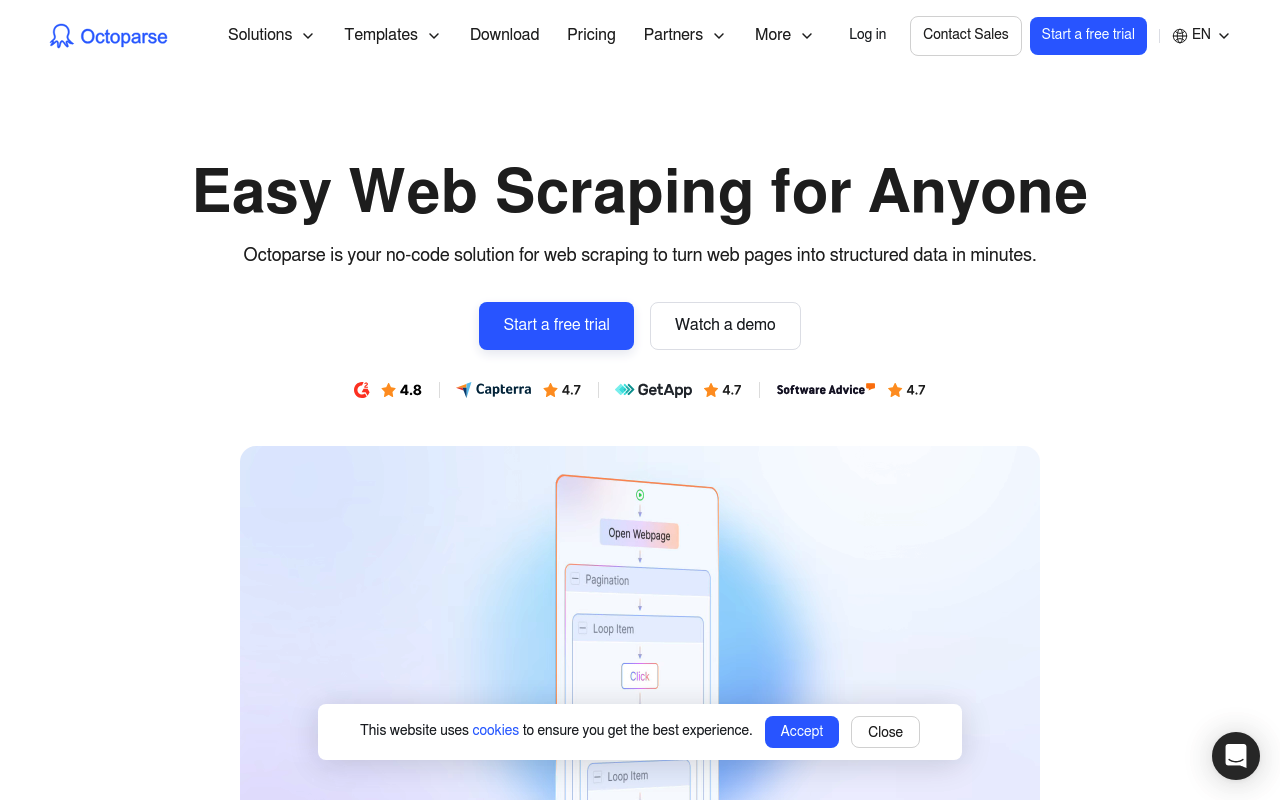
Octoparse provides a visual point-and-click builder, cloud extraction scheduling, and API endpoints to fetch the extracted datasets. It appeals to non-developer users who want cloud runs and templates for popular sites.
Key Features
- Visual scraper builder with point-and-click actions.
- Cloud extraction, scheduling, and a desktop client.
- API access to fetch extracted datasets.
- Pre-built templates for many popular sites.
- Desktop client combined with cloud platform.
Pricing
Octoparse offers a free tier and paid cloud plans; visit Octoparse for current tier pricing. Normalize cloud extraction pricing by estimating runs per month and average runtime per job to compute per-1,000-page costs.
Pros
- Rapid setup for non-developers using visual tools and templates.
- Cloud scheduling reduces the need to run local runners.
- API access available to programmatically retrieve results.
Cons
- May struggle with heavily protected or highly dynamic pages without custom work.
- Cloud extraction costs can grow for frequent or complex jobs.
- Less flexible for developers who require fine-grained control.
Verdict
Pick Octoparse if you want a visual scraping experience with cloud runs and API retrieval, and you are not building custom scripts at scale. Avoid Octoparse if you have heavy JS-heavy targets that need advanced rendering or if you are optimizing for low per-request cost at scale.
11. ParseHub
Overview
ParseHub is a visual data extraction tool with cloud execution and API access. It can handle AJAX and JS-heavy pages via its desktop and cloud runners, and exposes API endpoints to fetch datasets.
Key Features
- Visual editor for building scrapers with click-and-select actions.
- Handles AJAX and JavaScript-heavy pages with cloud execution.
- Cloud scheduling and dataset storage.
- API access to retrieve extract datasets.
- Desktop and cloud runner options.
Pricing
ParseHub has a free tier and paid plans; visit ParseHub for current tier pricing. Normalize pricing by expected runs per month and per-run runtime; check quotas on free plans for limits.
Pros
- Good balance for beginners and power users working with complex pages.
- Cloud scheduling and API retrieval enable automation.
- Robust handling of AJAX and JS pages in many cases.
Cons
- Some users report stability issues on very complex sites.
- No-code approach can limit edge-case custom logic; may require workaround.
- Support and scaling often need paid tiers.
Verdict
Pick ParseHub if you need a visual editor that can handle complex AJAX/JS workflows and you want API access to results. Avoid ParseHub for the most fragile targets or when you require repeated high-throughput stable runs without intervention; in those cases, consider Apify or a developer-focused API.
12. Phantombuster
Overview
Phantombuster provides pre-built automation “Phantoms” for social platforms and web interactions, with an API to trigger tasks and retrieve results. It targets marketing and growth teams that need to automate social platform actions and scrape platform data.
Key Features
- Pre-built Phantoms for LinkedIn, Twitter, Instagram, and other platforms.
- API to run Phantoms and retrieve results programmatically.
- Scheduling and chaining automations for workflows.
- Remote browser execution for automation tasks.
- Useful for growth automation and social scraping.
Pricing
Phantombuster offers a free tier with limited execution time and paid plans with team tiers listed on their pricing page; visit Phantombuster for current pricing. Normalize by estimating execution minutes per Phantom and the runs per month.
Pros
- Speeds social automation and data collection with ready-made tasks.
- Programmatic API to orchestrate runs and retrieve results.
- Good for marketing teams that need prototyping and rapid growth workflows.
Cons
- Platform terms of service and rate-limits on social networks constrain usage; be careful.
- Primarily targeted toward social automation rather than generic scraping.
- Execution limits and quotas are strict on lower tiers.
Verdict
Choose Phantombuster for social automation and growth-hacking workflows where pre-built Phantoms reduce development time. Avoid Phantombuster for large-scale general web scraping; social platform TOS and account-level restrictions make it a risky choice for heavy scraping. Use conservative settings, limit request bursts, and monitor account health to reduce the chance of bans.
Pricing normalization callout box
- We did not publish vendor prices here because many providers change tiers frequently. Use the normalization formula above and our downloadable spreadsheet to compute cost per 1,000 for your workload. For enterprise negotiation, always request a test quota to replicate your actual page mix, then extrapolate costs using measured average seconds per request.
Conclusion
If you want a single recommendation for most developer teams, start with ScraperAPI for turnkey proxy plus browser rendering. For SERP-focused projects pick SerpApi; for cost-sensitive JS rendering jobs pick ScrapingBee. Enterprises that need SLAs and managed pipelines should look at Zyte and Oxylabs, while Diffbot suits teams that need ML-driven semantic outputs. No-code or analyst-led teams should evaluate Import.io, Octoparse, and ParseHub for time-to-value. Always normalize vendor pricing to cost per 1,000 requests for your page mix and run a pilot with representative targets before committing to a contract. For more options, browse our full web scraping tools category or use our buyer checklist to narrow your shortlist.
Top 3 picks, quick summary
- ScraperAPI, Best for developer teams that need integrated proxy, rendering, and CAPTCHA handling without building infra. Starting point for mixed static and JS workloads.
- SerpApi, Best for high-fidelity, localized SERP scraping with normalized JSON across search engines. Ideal for SEO and competitive intelligence teams.
- ScrapingBee, Best for teams that prioritize cost-effective JS rendering and fast developer onboarding via clear docs and SDKs.
Frequently Asked Questions
What is the best web scraping API for SERP data and why?
SerpApi is the best fit for SERP data. It exposes dedicated endpoints for Google, Bing, Baidu, and others, returns structured JSON fields, and supports geo-localized queries. That avoids building fragile parsers and handling multiple SERP layouts. Source: https://serpapi.com
How do providers differ on handling JavaScript-heavy pages?
Differences lie in rendering approach: some vendors offer headless browser rendering (headless Chrome via Puppeteer/Playwright) while others are proxy-only. Headless browser providers like ScraperAPI, ScrapingBee, and Apify (including Apify actors) will execute JS. Proxy-first vendors may not render JS and require client-side execution or specialized crawler APIs. Source: vendor docs (ScraperAPI, ScrapingBee, Apify)
How should I compare pricing between scraping APIs, what does "per request" mean?
Normalize pricing to cost per 1,000 requests for your workload. Determine whether the vendor charges per request, per credit, or per compute-second, measure average compute per request for your target pages, and use the formula in the Pricing normalization section.
Are residential proxy services legal, and what compliance risks should I consider?
Residential proxies operate in a gray area. Legal risks depend on jurisdiction, target site TOS, and whether you collect personal data. Mitigate risk by consulting counsel, preferring datacenter proxies when possible, limiting personal data retention, and ensuring contractual data handling safeguards.
Which scraping API is easiest to integrate for developers?
ScrapingBee and ScraperAPI rate highly for integration simplicity, offering single-call REST GETs for rendered pages and SDKs in common languages. Developer docs and sample code reduce onboarding time significantly.
When should I choose a managed extraction service like Zyte or Diffbot versus a self-serve API?
Choose managed services if you require vendor-run pipelines, SLA-backed support, and structured outputs with little in-house parsing. Choose self-serve APIs if you want lower cost, control over scraping logic, and lighter support needs.
How do I reduce block rate and improve success rate when scraping at scale?
Use session management and IP rotation; throttle and randomize request timing; implement exponential backoff and respectful concurrency; cache results to reduce requests; and use headless browser rendering where content needs JS execution. Vendor features such as smart proxy pools and CAPTCHA handling help, but operational discipline matters most.
